Fluxus / Fluxus / Fluxus / Fluxus
Ensemble
Fluxus was a movement from the early of the 1960s which wanted to broaden the concept of art by eliminating the boundaries between the various disciplines, and seeking to fuse art and life.
Through the work of artists like Nam June Paik, George Brecht and George Maciunas, the founder of the movement, Joseph Beuys came into contact with Fluxus. In 1963 he co-organised the festival FESTUM FLUXORUM FLUXUS, MUSIK UND ANTIMUSIK – DAS INSTRUMENTELLE THEATER at Düsseldorf's Academy of Fine Arts, where he taught. Beuys's first two actions took place during this festival. From the mid-1960s onwards, he often worked together with Fluxus composer Henning Christiansen for his actions.
Beuys' ideas often collided with those of other members of the Fluxus movement. For example, Beuys rarely engaged the public in his performances, unlike his colleagues. However, Fluxus’ performative aspect significantly expanded Beuys artistic activities, and his interest in music and sound as part of the language of art developed greatly in the context of Fluxus.

Items
View all-

Drei teilen des Aktionsso...
Joseph Beuys, Drei teilen des Aktionssockels, 24 Stunden, 1965. Installation, orange box, glass bottle, plastic, adhesive tape, variable dimensions .
-
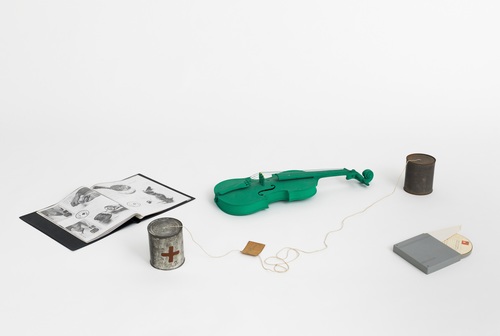
Zwei Fluxus-Objecte
Joseph Beuys, Zwei Fluxus-Objecte, 1974. Object, two tin cans, brown paint, string, paper flag, green gerabte violin, audio tape, vynil notebook, variable dimensions.
Actors
View all